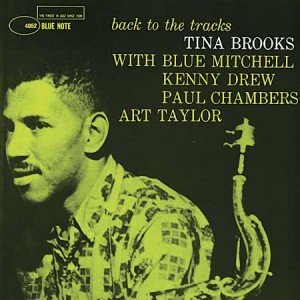
Tina Brooks (1932 – 1974)
“I loved Tina. “He had a nice feeling…. He would write shit out on the spot and it would be beautiful. He wrote ‘Gypsy Blue’ for me on the first record, and I loved it. I just loved it. Tina made my first record date wonderful. He wrote and played beautifully. What a soulful, inspiring cat.” – Freddie Hubbard
He was small of stature, soft spoken, bullied as a child and saddled with a woman’s name as a nickname from a very early age. But when he picked up that tenor sax… Harold Floyd “Tina” Brooks became a powerful giant.
He recorded just a handful of sessions as a leader for Blue Note Records between 1958 and 1961. Only one of them, True Blue, was released during his lifetime.
There are some musicians whose careers feel unfinished.
And then there are musicians whose recordings feel complete, even if their lives did not.
Tina Brooks belongs to the second category.
Harold Floyd Brooks was born in Fayetteville, North Carolina in 1932. His nickname was a variation on “Teeny”, which alluded to his small size. He grew up primarily in New York City. The sounds of rhythm & blues, church music, and the emerging language of bebop were part of the atmosphere there.
Music was already in the family. His father, David Brooks, sang professionally in vocal groups. This included the famed Ink Spots–style harmony ensembles that were popular in the 1940s. So Brooks grew up around working musicians. Jazz wasn’t a distant art form, it was a trade.
By his late teens, he had taken up the tenor saxophone. He began absorbing the language that dominated the New York scene of the early 1950s. Like many young tenor players of the period, he listened closely to Lester Young. He also paid attention to Dexter Gordon. Additionally, he absorbed the emerging modern vocabulary of Sonny Rollins.
But Brooks was not an imitator. Even early recordings reveal a voice that is inward and deliberate
Apprenticeship Years
Before recording under his own name, Brooks worked the New York club circuit and gained visibility through sideman work.
His first significant recording appearance was with Jimmy Smith. Smith’s revolutionary Hammond B-3 sound was redefining the organ trio format. Brooks appears on Smith’s 1958 Blue Note session The Sermon!, where his tenor sits comfortably inside the groove-oriented, church-inflected atmosphere Smith created.
It was a perfect setting for Brooks. His tone had a quiet blues authority; not flashy, but deeply rooted.
Around the same time, Brooks began working with alto saxophonist Jackie McLean, another rising voice in the Blue Note orbit. Their collaboration on Jackie’s Bag (recorded 1959) showcased Brooks alongside players such as Freddie Hubbard and Paul Chambers. This firmly situated him within the hard-bop movement of the period.
Yet even within these high-level sessions, Brooks rarely behaved like a player trying to steal the spotlight. His solos are thoughtful, measured, and structurally clear.
He sounded like someone thinking while playing.
The Blue Note Leader Dates
Between 1958 and 1961, Brooks recorded several sessions. They were all for Blue Note Records. Brooks worked with producer Alfred Lion and recording engineer Rudy Van Gelder.
These sessions included:
- Minor Move (1958)
- True Blue (1960)
- Back to the Tracks (1960)
- The Waiting Game (1961)
But here is the strange twist that shaped his reputation.
Only one of these albums, True Blue, was released during Brooks’ lifetime.
Tina Brooks did not record again past the age of 29. His other recordings sat in the Blue Note vault for years. They did not appear until the label’s archival reissues in the late 1970s and 1980s. These reissues brought renewed attention to overlooked sessions.
Why were they shelved?
No single explanation exists. Blue Note was recording prolifically at the time. Market decisions affected outcomes. Scheduling priorities interfered. The emergence of newer stars also played a role. Brooks’ personal struggles with health and addiction also complicated his career trajectory.
But the music itself tells a different story.
These are not tentative sessions. They are confident, mature statements from a fully developed modern tenor voice.
The Composer
One of Brooks’ most overlooked strengths was his writing.
Pieces such as:
- “True Blue”
- “Good Old Soul”
- “Minor Move”
are elegantly constructed hard-bop compositions that balance blues feeling with harmonic sophistication.
They sit comfortably alongside the writing of contemporaries like Hank Mobley and Horace Silver. However, Brooks’ tunes often have a slightly more introspective quality. He wrote two tracks that appeared on Freddie Hubbard’s debut album as a leader, Open Sesame.
They feel less like vehicles for blowing and more like small musical architectures.
The Sound
Brooks’ tone is distinctive once you learn to hear it.
It is:
- Lean rather than lush
- Focused rather than expansive
- Expressive without being demonstrative
Where John Coltrane pursued intensity and harmonic expansion, Brooks seemed more interested in clarity and pacing.
His solos unfold patiently. Ideas develop logically. There is very little excess.
You hear intention in every phrase.
The Quiet Fade
By the mid-1960s, Brooks’ health had deteriorated significantly. The combined pressures of the jazz lifestyle and personal struggles gradually removed him from the recording scene.
He died in 1974 at just forty-two years old.
By that time, his recorded legacy was already largely forgotten.
It would take the Blue Note reissue programs decades later for listeners to rediscover the depth of his work.
Today, albums like Back to the Tracks and Minor Move are often talked about with reverence. This is usually reserved for more famous artists.
But during his lifetime, Brooks never experienced that recognition.
Where to Begin (If You’re Listening Tonight)
If you’re discovering Brooks for the first time, start here:
- “True Blue” (Title track from True Blue) listen to the construction of his solo. Notice the pacing.
- “Good Old Soul” (Also on True Blue) the blues sensibility beneath modern harmony.
- “Minor Move” (Title track from Minor Move) lean, direct, unsentimental.
Don’t stream it casually. Sit with it.
Tina Brooks is not background music.
He is a study in understatement.
Why He Belongs in This Series
Jazz history tends to celebrate the revolutionaries.
The language of the music was shaped by musicians. They extended the tradition quietly. They worked thoughtfully and with immense discipline.
Tina Brooks was one of those musicians.
His discography is small.
His voice is unmistakable.
And that is why he belongs among the Unsung Tenor Giants.
Discography (all are on Blue Note Records)
(As a leader/co-leader)
True Blue (1960) with Freddie Hubbard, Duke Jordan, Sam Jones and Art Taylor
Minor Move (1958; Released 1980) with Lee Morgan, Sonny Clark, Doug Watkins and Art Blakey
(As a sideman[Partial])
Blue Lights Volume 1 & 2 [with Kenny Burrell] (1958)
Redd’s Blues [with Freddie Redd] (1961; Released 1998)
House Party [with Jimmy Smith] (1958)
Open Sesame [with Freddie Hubbard] (1960)
Jackie’s Bag [with Jackie McLean] (1961)
 Curt's Jazz Cafe