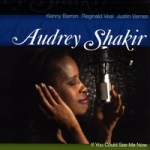
Vocalist Audrey Shakir will be performing at the Atlanta Jazz Festival on Saturday, May 28, at 5 pm. Ms. Shakir is a veteran of the New York jazz scene, who has performed with greats such as Kenny Barron, Duke Pearson and Lionel Hampton. She was also a regular performer at the late, lamented Village Gate nightclub.
She has also released an album, If You Could See Me Now, backed by Barron, Reginald Veal and drummer Justin Varnes. It’s available on CDBaby.
She has been an Atlanta resident since 1989 and has performed at many Atlanta area clubs and festivals, including the AJF.
You can read more about Audrey Shakir in Jason Crane’s 2007 article about her in The Jazz Session. You can also see her perform as a part of this 2010 video clip about Jazz Appreciation Month in Mobile, AL.
But better yet, why not catch Audrey Shakir live, at the Atlanta Jazz Festival, next Saturday. Hope to see you there.
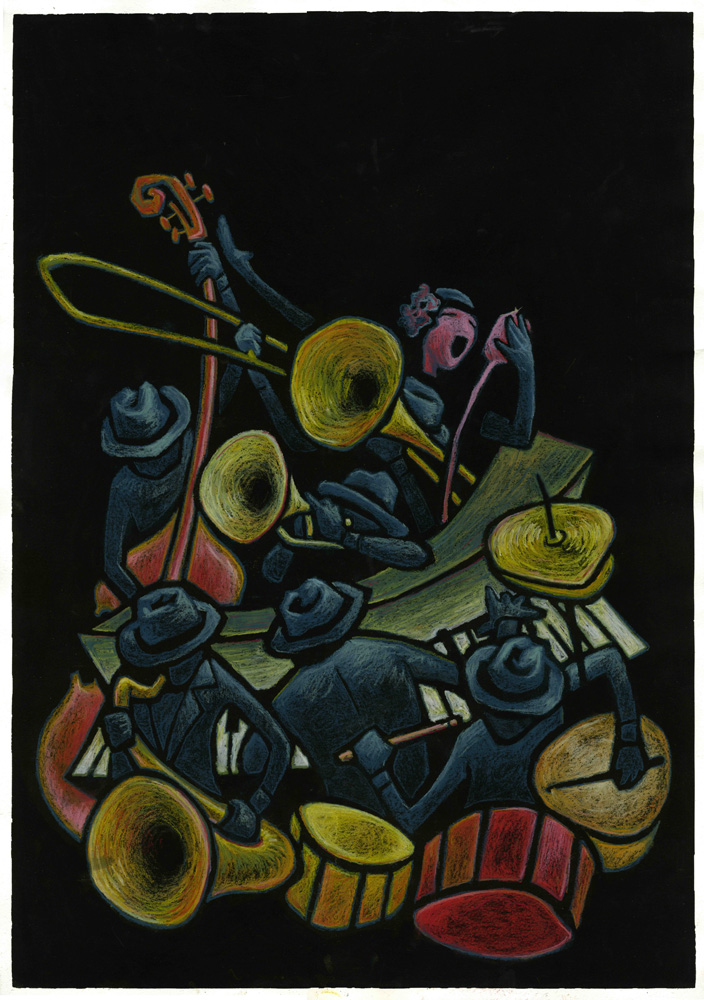
2011 Official AJF Artwork - created by Daniel Murdoch
I’ve lived in the South for over 10 years now. There’s much about my life here that I like, but I’ve always missed the easy access to great straight ahead jazz that New York always provided. Hell, even “smooth” jazz has become hard to find recently.
I’d recently settled into a certain amount of complacency about hearing jazz live. Basically, if it didn’t fall right into my lap. I admit, I didn’t make a lot of effort to find it. Well, that will change in 2011. There is a good deal of live jazz below the Mason-Dixon line, you just have to seek it, find it and then, here’s the hardest part…get off your “rusty dusty” and go.
Last Saturday night, my Queen and I were sitting around relaxing. Our son was asleep and the house was quiet. She looked up her work schedule for the next two weeks and discovered that she had been blessed with the entire Memorial Day weekend off. Excitedly, she said to me “Baby, we should do something!” We kicked around a few ideas, and then I remembered that the Atlanta Jazz Fest was traditionally on Memorial Day weekend.
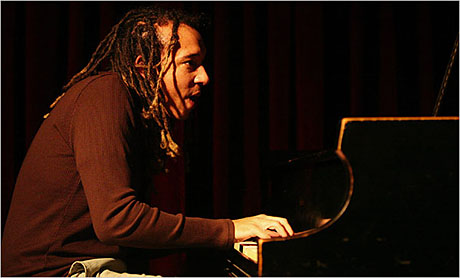
Gerald Clayton
I knew of the AJF, but hadn’t paid much attention in the past, because a) usually one (or both) of us had to work that weekend and b) I had assumed that it was another package of slick instrumentalists and R & B vocalists, passing itself off as a “jazz” festival. Don’t get me wrong, I dig some of these artists. Many are quite gifted; it’s just not what I look for when I want to hear jazz. Well, you know what happens when you assume.
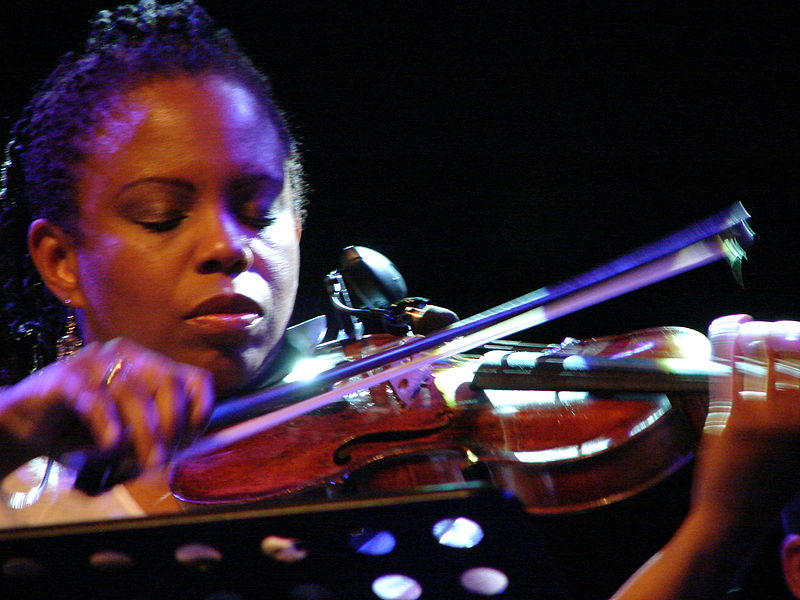
I looked at the lineup and saw Christian McBride, Regina Carter, Sean Jones, Gerald Clayton, Christian Scott and more…Okay, NOW I was excited! These are my people. This is a place that the fan and the writer in me wants to be.
Regina Carter
My wife, asked cautiously “Okay, how much are the tickets?” I looked down at computer screen and then looked up with what, judging from my wife’s reaction, must have been a look of maniacal joy and I slowly uttered “It’s…Free” (5/28 & 5/29). She repeated my words, I nodded and she said “Let’s GO!”
Sean Jones
Thanks to the miracle of online shopping, within 30 minutes we had reserved our hotel room, reserved a rental car and bought three new lawn chairs. I had to tell somebody about this, even if it was midnight, so I dropped a note on Twitter to share the news with our extended jazz family.
My excitement has been growing by the day since then. Great jazz is on my Southern doorstep again; and this time, I’m going to answer.
We will post something on the blog every day, from now until the Atlanta Jazz Festival; about the festival itself, the artists or our preparation. For more on the AJF 2011, visit their website http://atlantafestivals.com/
My mother loved life and lived it joyously. She loved to be around people, she loved to laugh and though she didn’t do it very well, she loved to sing. I still remember the sound of Mom’s singing voice as she was in the kitchen or at her sewing machine. However, even when I was a child, her singing sounded unusual to me. It was a bit affected and nasal. It sounded nothing like her speaking voice. I often wondered, but never asked, where in the world did it come from?
I also knew from an early age that my mom was a fan of Dinah Washington. Though Mom was not a big LP buyer, I noticed that there were three Dinah Washington albums in the storage side of the stereo console; more than any other artist. Mom also spoke often of hearing Dinah live back when she lived in Chicago. I never bothered to listen to those records – they belonged to my parents, so they had to be corny. Besides, one of them was a “Memorial Album”, so this Dinah lady was dead. Why should I listen?
Mom died of breast cancer when I was 28. I was a nascent jazz fan by then, but I was yet to develop the love for the classic female vocalists (Sarah, Ella, Billie, Anita, etc.), that I now possess. Not too long after Mom’s death, I was on a therapeutic Tower Records run, with a good friend, Mike, who was/is a big fan of vocalists. One of the things he picked up was a 2-LP Dinah Verve Collection.
We got back to his place to have a few beers and listen to our spoils. The first thing he dropped on the turntable was the Dinah album. After the brief swinging horn line she began to sing:
“If they asked me; I could write a book…”
I stopped talking and I listened intently. All at once it hit me. That was the sound that Mom was looking for, but never quite achieved. Consciously, or not, each time my mother sang, she was paying tribute to her favorite vocalist: “Miss D”.
From that night on, Dinah Washington became my favorite jazz vocalist. The others are all great in their own way, but Dinah – well, she’s special…
“With jazz, you’re not interpreting; you’re composing on the spot. You have to develop your technique to the highest level so you are able to respond to a flow of creative ideas immediately. You should listen to everything — I listen to Ravel, Stravinsky, Schoenberg, Beethoven — so all that will go into your creative soul. Then you can call upon all kinds of music during performances. That’s the thrill. That’s the challenge and that’s the beauty of jazz.” – Valerie Capers
How Dr. Valerie Capers has managed to remain obscure is a mystery. The good news though is that this brilliant pianist/composer/singer/educator is still with us and a vibrant part of the scene. So we can all make up for lost time.
Born and raised in the Bronx, Valerie Capers was picking out tunes on the piano at an early age. She lost her sight at the age of six. While blindness may have been a deterrent to some, it was not for young Valerie. She learned to read music by braille and received her early schooling at the New York Institute for the Education of the Blind. She then went on to obtain both her bachelor’s and master’s degrees from The Julliard School of Music, the first blind person to graduate from the famed arts school. She was a classical player at the time, but jazz had always been a part of her life. Her father was a musical associate of Fats Waller and her brother Bobby, played sax and flute in Mongo Santamaria’s band. For a brief time in the early ‘60’s, Valerie joined her brother in Mongo’s group, composing and arranging a few tracks for the legendary percussionist, including the minor hit “El Pussycat”.
[Sony will not allow me to embed a clip of “El Pussycat” in my blog. Click HERE to view it on YouTube.]
In 1965, Dr. Capers recorded her first album, Portrait in Soul, for Atlantic Records. It was a very good jazz sextet date, with a strong soul influence; not atypical of the era. Saxophonist Robin Kenyatta was the most notable member of the group. Though Dr. Capers would not record again as a leader until Affirmation in 1982, she was still very active; working with Dizzy Gillespie, Tito Puente and James Moody, among others. She wrote major jazz based works, such as Sing About Love, a Christmas Cantata, that was produced by George Wein at Carnegie Hall and Sojourner, an “operatorio” based on the life of Sojourner Truth.
From her first album Portrait in Soul, Valerie Capers plays “Little David Swing”
Capers served on the faculty at Manhattan School of Music and then for many years, at Bronx Community College, where she became chair of the music and arts department, in 1987. Also in 1987, Valerie Capers became the first recipient of Essence magazine’s first Women of Essence Award, for music.
Dr. Capers made her best known recording, Come on Home, in 1995. It was part of Columbia Records’ “Legendary Pioneers of Jazz” series, but as Scott Yanow points out on allmusic.com, “ Valerie Capers is much too obscure and under-recorded to be a legend, and not old enough to be a pioneer. “ Nevertheless, Come on Home is an excellent album, mixing well-known jazz and pop standards with a couple of Capers’ originals. Jazz luminaries Bob Cranshaw, Paquito D’Rivera, Mongo Santamaria and Wynton Marsalis, take things to an even higher level on their guest appearances.
From Come on Home, Valerie Capers plays “In a Mellow Tone”
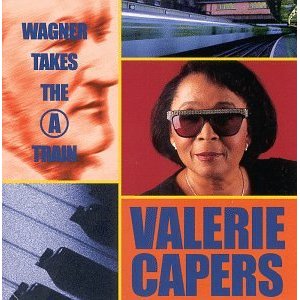
She followed-up, four years later, with the critically acclaimed Wagner Takes the “A” Train; which is highlighted by the title track, a slightly Wagnerian interpretation of Billy Strayhorn’s classic; and by her version of “‘Round Midnight” which explores several variations on the famous Monk theme in a little over eight minutes.
Although Valerie Capers retired from the Bronx Community College faculty in 1995, her educational endeavors have hardly skipped a beat. At 75, she is still based in her beloved Bronx; performing, recording and touring the U.S. and the world, never missing an opportunity to spread the gospel of jazz, leavened with her uniquely informative perspective. Her website http://www.valeriecapers.com/ includes a great deal of information on what Dr. Capers is up to. Check out the site and catch her live if she’s in your area. You’ll be in for a real treat.
Dr. Valerie Capers tells an anecdote about Dizzy Gillespie, then plays “A Night in Tunisia” [Special Thanks to Dawn Russell’s Bongodawn Productions for this clip]
“When I walked home from school, I passed the pool parlor and the Mardi Gras and they always had jazz playing. My mother was saying ‘No!’, but the music was sensuous and it said, ‘Yes!'” – Patti Bown
Pianist Patti Bown was a childhood friend and musical partner of the great Quincy Jones, a longtime member of Gene Ammons’ band and the composer of a minor jazz classic. Yet more often than not, writers and even venerable jazz anthologists can’t even spell her name right. I can’t tell you how many times she is listed as Patti Brown, by those who are apparently slaves to their spell check.
Patti Bown [pronounced “bone”] was born in Seattle in 1931, one of seven children. She was raised in a home that was filled with music and the arts. She stunned her family at three by sitting down at the family piano and playing a Duke Ellington tune that she had just heard on the radio. Her sister, Edith Mary Valentine, became a classical concert pianist. Patti however, went in a different direction; playing jazz. One of her childhood playmates also loved that music: Quincy Delight Jones (reportedly, they used to play “house” together as kids). Ms. Bown learned how to accompany a soloist from another pianist friend of “Q”; Ray Charles.
Her musical skills won Patti a scholarship to Seattle University, then to University of Washington and finally to the Big Apple, which became her home for the rest of her life. Patti quickly earned a rep as a good sight-reader and improviser, which made in great demand in the studio.
[Patti Bown, with Clark Terry, Phil Woods and Sahib Shihab – “Ornithology”]
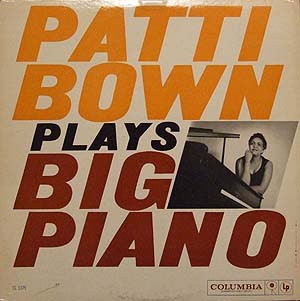
In 1958, she recorded her only album, a trio date for Columbia: Patti Bown plays Big Piano; with Ellingtonian Joe Benjamin on bass and Ed Shaughnessy (who would soon achieve fame on Johnny Carson’s Tonight Show) as the drummer. To these ears, Ms. Bown was an excellent technical pianist, rooted in bop but with a strong dose of gospel-soul in her left hand. For comparison, think Bobby Timmons or the pre-fusion Ramsey Lewis. Perhaps her similarity in style to those gentlemen, who were her contemporaries, contributed to her dearth of recordings as a leader.
[Patti Bown w/ Terry, Woods, Shihab, et al – “Straight No Chaser”]
However, Ms. Bown was still very busy. The next year, old playmate Quincy called her for his 1959-60 European tour and for his classic album The Quintessence. She also did some writing, as Q added her soulful shuffle “G’won Train” to his book. It became a Jones staple and it can be heard on several of his recordings of that era.
[Quincy Jones’ Big Band (1960) w/ Patti Bown on piano – “Birth of a Band”]
Other artists also dug “G’won Train” too, especially Jimmy Smith, who recorded a hard swinging version of it on Any Number Can Win. It was a minor chart hit for J.O.S. [UMG would not permit me to embed a clip of this track in my post. Click here to view/hear it on YouTube]. She also found regular work with Gene Ammons, Oliver Nelson and Cal Tjader during this period.
Patti Bown with Gene Ammons “The Party’s Over” from Late Hour Special
As the tide turned away from jazz in the ‘70’s, Patti Bown faded from the scene. She supported herself by working as a pianist in the pit orchestras of Broadway shows. But she could still be counted on to occasionally drop in and thrill an audience at the Village Gate or at various jazz festivals. Famed jazz critic Whitney Balliett was a big fan, describing her performance at a Newport ’75 Jam Session as “a mischievous wonder. She is an intense performer…Her own improvisations are hard-swinging précis of longer, more elaborate statements that she edits in her head.”
By the time Patti Bown died in 2008, she had become a beloved figure among the NYC jazz crowd. The memorial tribute for Patti at New York’s St. Peter’s church drew many jazz luminaries, past and present that were anxious to share their fond memories of the “pianist/singer/actress/diva/child prodigy/mad woman”. [ Click here to see a great clip of Annie Ross singing/reminiscing at the tribute]
Patti Bown, remember her name…and make sure that you spell it correctly!
Recommended Recordings:
Patti Bown Plays Big Piano (Columbia) – [LP only] OOP. But it can be had for a reasonable price if you search online or at larger used record shops.
Late Hour Special [Gene Ammons] (Original Jazz Classics) – CD in print; mp3 available
Fantabulous[Oliver Nelson] (Verve) – CD in print; mp3 available
I Dig Dancers [Quincy Jones] (Mercury – Import) – CD in print
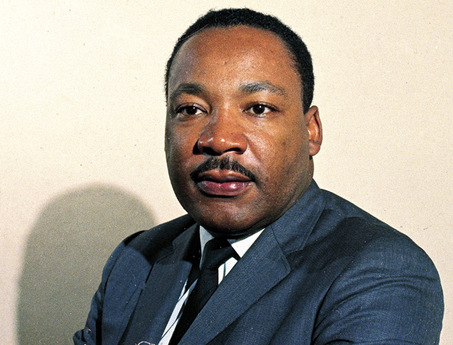
“It is no wonder that so much of the search for identity among American Negroes was championed by Jazz musicians. Long before the modern essayists and scholars wrote of racial identity as a problem for a multiracial world, musicians were returning to their roots to affirm that which was stirring within their souls.” – Dr. Martin Luther King, Jr.
Martin Luther King, Jr. was assassinated 43 years ago today in Memphis, TN.
Though I was not quite eight years old at the time, my recollection of some things about that day are still quite vivid.
My parents were tailors who ran their business out of the basement of our Long Island home. I remember them working that evening at their sewing machines, which sat at right angles to each other. I sat with one of my coloring books and my Crayolas at the massive cutting table in the center of the room, working on my latest masterpiece.
WGLI, the local top 40 radio station, was playing on the AM table radio on top of the fabric shelf, when the deejay broke in with the news that Dr. King had been shot in Memphis.
Both of my parents stopped what they were doing. My mother spoke first, saying to my dad “John, did you hear that?”. My father immediately went to the radio and switched it to WINS, the all news station. By the time he got the New York City signal, the news had gotten worse. Dr. King was now dead.
My dad was a stoic man. In his era, men did not display great emotion. Though he laughed easily, tears were just not an option. So, as my mother cried out “Jesus!”, my father quietly uttered what for him, was a wail of grief: “Ummf, Ummf, Ummf…”, each one with increasing emphasis.
We had no TV in the basement workshop. But neither of my parents moved yet to go upstairs and turn the TV on. They seemed to be hoping that if they remained in the basement long enough, somehow when they did go upstairs, Walter Cronkite would make the radio out to be a liar.
By now, my mother was working the phone, calling friends, neighbors and relatives and checking to see if they had heard the news. My dad had sat back down at his sewing machine and he tried to return to work. I saw a little tear form in the corner of his eye and make its way silently down his cheek.
I knew of Dr. King. I knew he was a great man, because my parents had told me so; but at this point, he was still years from having a profound affect on my life. I was seven; all I really knew is that I had never seen my father cry. So, I asked my dad what was wrong. He just responded gently “Nothing…I’m alright, Curtis…” and his voice trailed off. A few minutes later he shut off his machine, went upstairs and turned on the television. He would not return to the basement that night. Dad generally worked seven days a week, from 7 a.m. until the end of the 10 O’Clock News; this was major indeed.
By the time of Dr. King’s funeral a few days later, the small black and white TV had been moved to the basement. My dad had gone to great lengths to set up the antenna to get reception. I don’t know if it was Easter Recess or not, but I remember being off from school that day. My parents tried to work but couldn’t, as they watched the scene play out in Atlanta.
My mom cried throughout the service. My dad maintained quiet composure until the portion where they played the excerpt from Dr. King’s final Ebenezer sermon (“The Drum Major Instinct”). At that point, he began to weep openly.
Over the years, I’ve become a student of Dr. King. I’ve read and researched copious amounts of information concerning his life, his ministry and his work. I did this because I wanted to know about the man, warts and all; not the deity that our society has created. Frankly, the more I’ve gotten to know about his successes and his shortcomings, the more my admiration for Dr. King has grown.
One thing I did not learn until a few years ago was that Dr. King had a great respect for jazz. When asked by an acquaintance, he penned some eloquent and profound words that were used as the foreword to the program from the 1964 Berlin Jazz Festival.
We end this remembrance with those words and with a musical tribute by the late, great Dr. Billy Taylor:
God has wrought many things out of oppression. He has endowed his creatures with the capacity to create—and from this capacity has flowed the sweet songs of sorrow and joy that have allowed man to cope with his environment and many different situations.
Jazz speaks for life. The Blues tell the story of life’s difficulties, and if you think for a moment, you will realize that they take the hardest realities of life and put them into music, only to come out with some new hope or sense of triumph.
This is triumphant music.
Modern jazz has continued in this tradition, singing the songs of a more complicated urban existence. When life itself offers no order and meaning, the musician creates an order and meaning from the sounds of the earth which flow through his instrument.
It is no wonder that so much of the search for identity among American Negroes was championed by Jazz musicians. Long before the modern essayists and scholars wrote of racial identity as a problem for a multiracial world, musicians were returning to their roots to affirm that which was stirring within their souls.
Much of the power of our Freedom Movement in the United States has come from this music. It has strengthened us with its sweet rhythms when courage began to fail. It has calmed us with its rich harmonies when spirits were down.
And now, Jazz is exported to the world. For in the particular struggle of the Negro in America there is something akin to the universal struggle of modern man. Everybody has the Blues. Everybody longs for meaning. Everybody needs to love and be loved. Everybody needs to clap hands and be happy. Everybody longs for faith.
In music, especially this broad category called Jazz, there is a stepping stone towards all of these. – Dr. Martin Luther King, Jr. (September, 1964)
“This isn’t just a novelty, though that is what you expect. The harp has a clean jazz voice with a resonance and syncopation that turn familiar jazz phrasing inside out.”– Dorothy Ashby
The harp is not an instrument that easily gives itself over to free swing and quick improvisations. That’s one of the reasons why there have been very few credible jazz harpists. In fact, I can only think of four working today: Lori Andrews, Edmar Castaneda, Deborah Henson-Conant and Brandee Younger.
Dorothy Ashby was a pioneer. She was the first to play credible bebop on the harp. She showed that this unwieldy instrument could actually swing.
She was born Dorothy Jeanne Thompson in Detroit, in 1932. Her father was a jazz guitarist, who would often bring home fellow musicians to jam. Young Dorothy would be a part of some of these sessions, sitting in on piano. She attended Detroit’s famed Cass Technical High School, where her classmates included jazz luminaries Kenny Burrell and Donald Byrd. Her early instruments were the sax and the bass before turning to the harp. She studied piano and music education at Wayne State University.
In 1952, Dorothy set out to make a living on the competitive Detroit jazz scene. She easily could have found work as a pianist, but she made the gutsy decision to concentrate on her beloved harp. The cats in Detroit weren’t too keen on making the harp and its perceived ethereal, effete sound part of a jazz combo. To overcome this resistance, Dorothy organized free shows and played at dances and weddings with her harp-led combo, which included her husband, John Ashby, on drums. Eventually she won doubters over and the gigs and recordings began to come with some regularity.
Her first full jazz LP, The Jazz Harpist, was recorded for Savoy in 1957, with Frank Wess on flute, Eddie Jones and Wendell Marshall on bass and Ed Thigpen on drums. The album was a mix of standards, such as “Thou Swell” and “Stella by Starlight”, and Ms. Ashby’s originals. It was critically well received, but the record buying public ignored it. Her next album Hip Harp, (1958) on Prestige, was one her best, with Wess, Dave Brubeck’s bassist Gene Wright and Art Taylor on drums. In all Dorothy led ten sessions between 1957 and 1970 Atlantic, Cadet and many other labels.
She was fearless in her musical choices as she played not just bop, but soul, Brazilian, African, Middle Eastern and like her contemporary (and other great jazz harpist) Alice Coltrane, free jazz. Ms. Ashby pioneered the use of the Japanese koto in jazz on her 1970 album The Rubaiyat of Dorothy Ashby, which was somewhat maligned in its time, but has become appreciated as an iconoclastic marriage of soul, world music and free jazz.
Music was not Dorothy Ashby’s only love. In the ‘60’s Dorothy and her husband formed a theatrical group in Detroit that produced plays with theme’s relevant to the Motor City’s black community. The group went by several names, the most common being “The Ashby Players”. Many of these productions were musical, with John writing the scripts and Dorothy the music and lyrics, as well as playing harp, piano and leading the musicians. In the late ‘60’s the Ashbys moved to California and continued their theatrical endeavors. Among the actors in their early California troupe was Ernie Hudson, of Ghostbusters fame.(
Dorothy also sought work as a harpist in the Los Angeles area recording studios in the early ‘70’s, which was no small feat considering that there were quite a few harpists out there already. However, she had made the acquaintance of singer Bill Withers, who used her on his classic + ‘Justmentsalbum. Bill introduced Dorothy to Stevie Wonder, who happened to be working on the sessions that would become Songs in the Key of Life. He had written a tune that was meant to be a duet between himself and a harpist. Stevie had Alice Coltrane in mind, but she was unavailable at the time of the recording session. So instead, he called Dorothy Ashby. Those who don’t know another thing about Ms. Ashby’s music know her unforgettable performance on “If it’s Magic”.
(I had hoped to insert a clip of “If It’s Magic”, but EMI’s corporate blockers made it impossible. You can hear the clip on YouTube. Sorry! – CD)
That performance opened studio doors for Dorothy. Jazz was struggling in the late ‘70’s but Dorothy was very busy, recording with artist such as Earth, Wind and Fire (All ‘n All), The Emotions, Rick James and The Gap Band. Though she would not record another album as a leader, she continued to work steadily until her death from cancer in 1986.
Though Dorothy Ashby is still far from well-known, young musicians with a respect for history such as the aforementioned Brandee Younger are thankfully, doing their part to keep Dorothy Ashby’s legacy alive.
Check out Dorothy Ashby. She may not have been the first, but she was truly an original.
(Brandee Younger Trio performs “Blue Nile”)
Recommended Recordings:
In a Minor Groove (Prestige) – [A compilation of Hip Harp and In a Minor Groove; Ashby’s two Prestige albums] CD in print
Our newest Obscure Jazz Masters series will deal not with an instrument, but with gender.
I’ve seen many articles and musical compilations that deal with “Women in Jazz” but most seem to overwhelmingly favor singers. The reason is kind of understandable. For so long, “vocalist” has been the dominant role of women in jazz. And yes, the list of great female jazz singers could fill many a book and blog and start many unwinnable arguments.
However, the list of legendary female instrumentalists is much smaller. If asked to name ten great jazzwomen who didn’t sing, many people will start with the great pianist Mary Lou Williams, perhaps follow with organist Shirley Scott and then begin to mumble and stare at their shoes.
It’s not the fault of the artists. From its roots, jazz has been a male dominated genre, except for the singers. Women on an instrument have often been viewed unfortunately, as a novelty act; especially if they play anything but the piano. And even then, many fine women pianists have been pushed toward singing, in order to make themselves more “palatable” to mainstream audiences (as if a woman displaying instrumental virtuosity would frighten children or something!).
Thankfully, times have begun to change, albeit at a glacial pace. Though there is still a considerable amount of chauvinism in many corners of the jazz world, I’ve been encouraged of late by the number of very good female instrumentalists that I see on the regularly on the jazz scene; Ingrid Jensen, Anat Cohen, Sherrie Maricle and the indomitable DIVA Jazz Orchestra, Geri Allen, Cindy Blackman, Tia Fuller and of course, Grammy Winner Esperanza Spalding are just a few of the women who are kicking down the boys club door. These artists (and more) offer uncompromising musicianship at a level of excellence that makes their gender irrelevant.
So this next series of undeservedly obscure jazz masters will consist of ten women instrumentalists. Most of them are not active today, but all of them had a lot to say with their axes.
Some of them will be familiar names to those well versed in the idiom, but that’s cool. My objective with these series is not to stump the cognoscenti, but to bring someone new to the attention of the casual to moderate jazz listener.
I’ve tried to provide a few available recordings and musical samples by each of the artists; so if you dig them, you can buy their music… better late than never.
They will be listed in alphabetical order; one per post; starting with the next post, tomorrow, April 1.
Please feel free to leave comments. I love reading them, I will post them all (unless they are obscene or spam) and I try to respond to as many as possible.
As I write this brief post, I’m digging The Lost and Found, the latest CD from the wonderful young jazz singer Gretchen Parlato, which hits the streets a week from today (Tuesday, 4/5). I’m hearing it courtesy of NPR’s terrific “First Listen”, which allows listeners to stream selected works in their entirety prior to their release.
I’ll resist the temptation to review the album, since I’m still in the process of listening to it. But I will say that I was a fan Ms. Parlato’s first two CD’s and six tracks into this one, which was co-produced by Robert Glasper, I’ve found nothing to disappoint me. In fact, I’m sitting here typing and listening with a beatific smile on my face, so I’d say that we’re off to a good start.
But don’t take my word for it, listen for yourself by clicking on the link below.
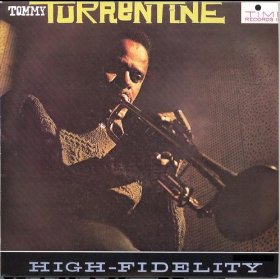
As a trumpet soloist Turrentine had all the qualities necessary for greatness. He had a full, warm tone throughout the range of the instrument and possessed the ability to create solos using long unbroken lines. His flair for melodic improvisation using long climaxes often contrasted sharply with the more disjointed creations of younger men who seemed anxious to brush aside convention. – Alun Morgan
He was the older brother of one of the most famous jazz musicians of the ‘60’s and ‘70’s. His kid brother recorded dozens of albums, including a few that are fondly remembered as classics. He was every bit the musician that baby brother was. Yet Stanley Turrentine is a bona fide jazz legend, while Tommy Turrentine, who recorded only one album as a leader in his entire career, is unknown to all but ardent jazz fans and the many musicians who still marvel at his gifts, both as a trumpet player and as a composer.
Thomas Walter Turrentine, Jr. was born in Pittsburgh in 1928, six years before Stanley. He joined Benny Carter’s Big Band at eighteen. In his early twenties, he played with Billy Eckstine, Dizzy Gillespie and briefly with Count Basie. He and Stanley then joined Earl Bostic in 1952 for a three-year bid.
In 1959, the Turrentine brothers received their first major exposure when they joined Max Roach’s quintet. There, Tom and Stan took part in some enduring works, including Quiet as it’s Kept; Abbey Lincoln’s Abbey is Blueand the drum battle Rich vs. Roach. In 1960, while with Roach, he also recorded his first (and last) album, the eponymous Tommy Turrentine. He was backed by his Roach bandmates plus pianist Horace Parlan. Tommy Turrentine’s compositions took center stage, as he wrote five of the seven tracks on this solid and swinging date, which went unnoticed for the most part.
Ironically, Tommy Turrentine drew more attention for his work as a sideman, subsequent to his own album. Stanley signed with Blue Note in 1961. Tommy came along as a sideman on Stan’s first Blue Note album Comin’ Your Way. Tommy also wrote the track “Thomasville” for that record; one of his most enduring compositions. Tommy was not done yet for Blue Note; that year as he also played on and/or contributed tunes to Parlan’s On the Spur of the Moment and Up & Down; Jackie McLean’s A Fickle Sonance and Sonny Clark’s classic Leapin’ and Lopin’. In 1962-63, he added Stanley’s Jubilee Shout!!!, That’s Where it’s Atand Never Let Me Go; Big John Patton’s Blue Johnand Lou Donaldson’s The Natural Soulto his performing and writing credits.
(“Sow Belly Blues” from Lou Donaldson’s The Natural Soul. Tommy Turrentine – trumpet)
Though he was the technical equal of Blue Note’s rising trumpet stars Freddie Hubbard and Lee Morgan, he wasn’t as personally brash as those two. Perhaps that intangible was the missing element that kept Tommy Turrentine from greater prominence. He was also said to suffer from some health problems that curtailed his work. Whatever the reason, Tommy Turrentine pretty much faded into obscurity by the mid ‘60’s; around the same time that Stanley was rising towards the pinnacle.
(From Sonny Clark’s Leapin’ and Lopin’ – “Midnight Mambo” – Tommy Turrentine; composer and trumpet)
He would appear on a few albums (including interestingly enough, one with Sun Ra in 1988) and at a few club dates here and there, but by the ‘70’s, Tommy Turrentine, the musician, was in semi-retirement, with his wife, in his New York City brownstone. Tommy Turrentine, the composer, the teacher and the mentor, never stopped working however, until his passing in 1997. Like Idrees Sulieman (Obscure Trumpet Master #9) he wrote many compositions that went unperformed and were published by Don Sickler’s Second Floor music. The four that are included in Brian Lynch’s Unsung Heroes series, are all memorable.
(From Unsung Heroes; Vol.2 – Brian Lynch Sextet debuting Tommy Turrentine’s “It Could Be”)
His knowledge of jazz and the people who played it is one of the reasons why, though the public’s favorite Turrentine was Stanley, many musicians still remember Tommy with great respect and fondness.
(Tommy Turrentine from the NYPL’s Jazz Oral History Series (1993))
This is the final post in the Obscure Trumpet Masters Series. I’m humbled to know that so many jazz fans and musicians have taken the time to read all or part of this labor of love. Special thanks to Brian Lynch, Dave Douglas and Jason Parker (three modern-day trumpet masters who deserve to be heard more often) for their words and tweets of encouragement.
I also appreciate the suggestions from everyone, for other fine artists who should be on this list. Since this was never intended to be an exhaustive study, I knew that there would be many great, underappreciated players who would not be mentioned. But I say to fans of trumpet masters such as Dupree Bolton, Richard Williams, Guido Basso, Tomasz Stanko, Howard McGhee and many others; y’all have given me some food for thought and additional study. Hmmm…perhaps there will be a second series.



 Curt's Jazz Cafe