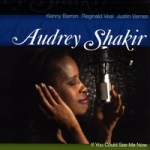
Vocalist Audrey Shakir will be performing at the Atlanta Jazz Festival on Saturday, May 28, at 5 pm. Ms. Shakir is a veteran of the New York jazz scene, who has performed with greats such as Kenny Barron, Duke Pearson and Lionel Hampton. She was also a regular performer at the late, lamented Village Gate nightclub.
She has also released an album, If You Could See Me Now, backed by Barron, Reginald Veal and drummer Justin Varnes. It’s available on CDBaby.
She has been an Atlanta resident since 1989 and has performed at many Atlanta area clubs and festivals, including the AJF.
You can read more about Audrey Shakir in Jason Crane’s 2007 article about her in The Jazz Session. You can also see her perform as a part of this 2010 video clip about Jazz Appreciation Month in Mobile, AL.
But better yet, why not catch Audrey Shakir live, at the Atlanta Jazz Festival, next Saturday. Hope to see you there.
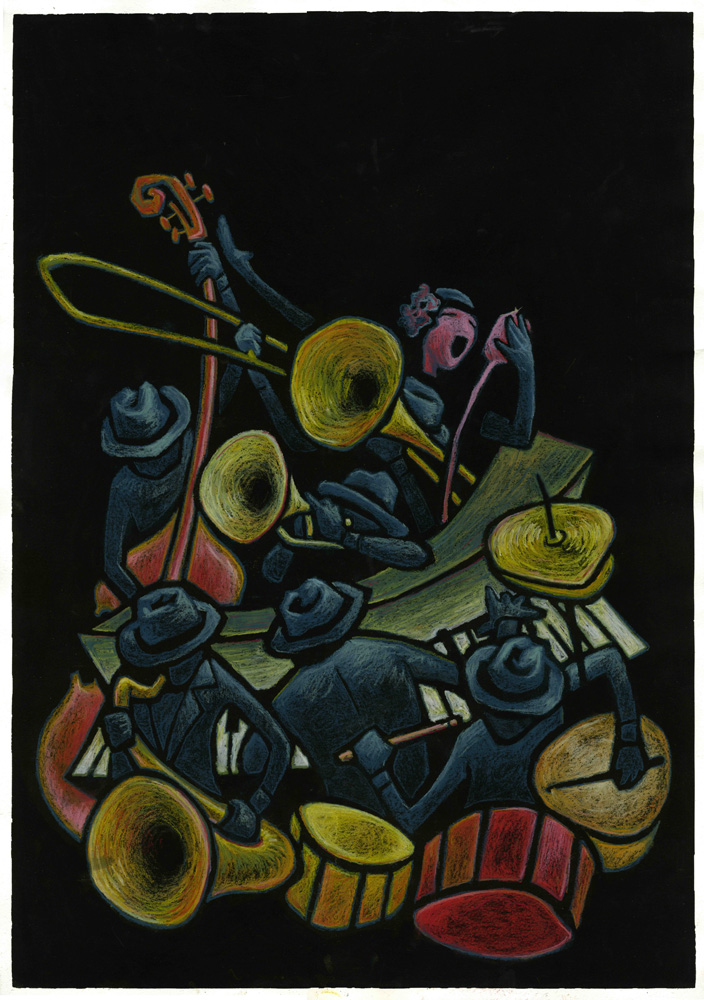
2011 Official AJF Artwork - created by Daniel Murdoch
I’ve lived in the South for over 10 years now. There’s much about my life here that I like, but I’ve always missed the easy access to great straight ahead jazz that New York always provided. Hell, even “smooth” jazz has become hard to find recently.
I’d recently settled into a certain amount of complacency about hearing jazz live. Basically, if it didn’t fall right into my lap. I admit, I didn’t make a lot of effort to find it. Well, that will change in 2011. There is a good deal of live jazz below the Mason-Dixon line, you just have to seek it, find it and then, here’s the hardest part…get off your “rusty dusty” and go.
Last Saturday night, my Queen and I were sitting around relaxing. Our son was asleep and the house was quiet. She looked up her work schedule for the next two weeks and discovered that she had been blessed with the entire Memorial Day weekend off. Excitedly, she said to me “Baby, we should do something!” We kicked around a few ideas, and then I remembered that the Atlanta Jazz Fest was traditionally on Memorial Day weekend.
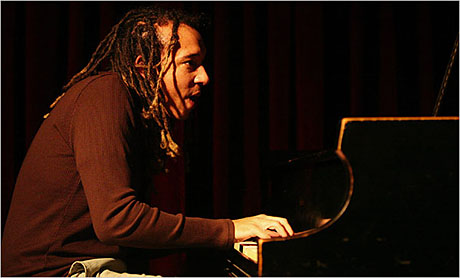
Gerald Clayton
I knew of the AJF, but hadn’t paid much attention in the past, because a) usually one (or both) of us had to work that weekend and b) I had assumed that it was another package of slick instrumentalists and R & B vocalists, passing itself off as a “jazz” festival. Don’t get me wrong, I dig some of these artists. Many are quite gifted; it’s just not what I look for when I want to hear jazz. Well, you know what happens when you assume.
I looked at the lineup and saw Christian McBride, Regina Carter, Sean Jones, Gerald Clayton, Christian Scott and more…Okay, NOW I was excited! These are my people. This is a place that the fan and the writer in me wants to be.
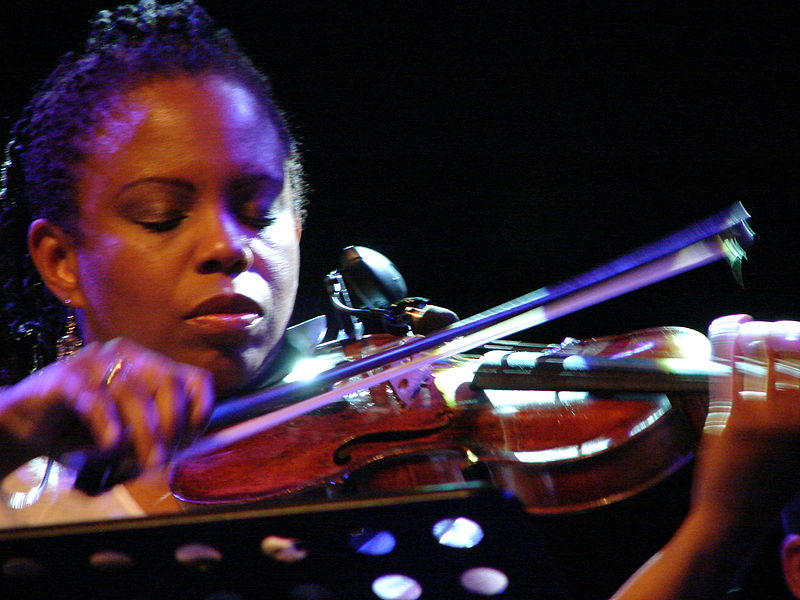
Regina Carter
My wife, asked cautiously “Okay, how much are the tickets?” I looked down at computer screen and then looked up with what, judging from my wife’s reaction, must have been a look of maniacal joy and I slowly uttered “It’s…Free” (5/28 & 5/29). She repeated my words, I nodded and she said “Let’s GO!”
Sean Jones
Thanks to the miracle of online shopping, within 30 minutes we had reserved our hotel room, reserved a rental car and bought three new lawn chairs. I had to tell somebody about this, even if it was midnight, so I dropped a note on Twitter to share the news with our extended jazz family.
My excitement has been growing by the day since then. Great jazz is on my Southern doorstep again; and this time, I’m going to answer.
We will post something on the blog every day, from now until the Atlanta Jazz Festival; about the festival itself, the artists or our preparation. For more on the AJF 2011, visit their website http://atlantafestivals.com/
My mother loved life and lived it joyously. She loved to be around people, she loved to laugh and though she didn’t do it very well, she loved to sing. I still remember the sound of Mom’s singing voice as she was in the kitchen or at her sewing machine. However, even when I was a child, her singing sounded unusual to me. It was a bit affected and nasal. It sounded nothing like her speaking voice. I often wondered, but never asked, where in the world did it come from?
I also knew from an early age that my mom was a fan of Dinah Washington. Though Mom was not a big LP buyer, I noticed that there were three Dinah Washington albums in the storage side of the stereo console; more than any other artist. Mom also spoke often of hearing Dinah live back when she lived in Chicago. I never bothered to listen to those records – they belonged to my parents, so they had to be corny. Besides, one of them was a “Memorial Album”, so this Dinah lady was dead. Why should I listen?
Mom died of breast cancer when I was 28. I was a nascent jazz fan by then, but I was yet to develop the love for the classic female vocalists (Sarah, Ella, Billie, Anita, etc.), that I now possess. Not too long after Mom’s death, I was on a therapeutic Tower Records run, with a good friend, Mike, who was/is a big fan of vocalists. One of the things he picked up was a 2-LP Dinah Verve Collection.
We got back to his place to have a few beers and listen to our spoils. The first thing he dropped on the turntable was the Dinah album. After the brief swinging horn line she began to sing:
“If they asked me; I could write a book…”
I stopped talking and I listened intently. All at once it hit me. That was the sound that Mom was looking for, but never quite achieved. Consciously, or not, each time my mother sang, she was paying tribute to her favorite vocalist: “Miss D”.
From that night on, Dinah Washington became my favorite jazz vocalist. The others are all great in their own way, but Dinah – well, she’s special…
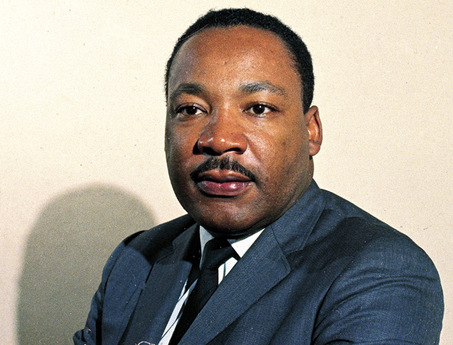
“It is no wonder that so much of the search for identity among American Negroes was championed by Jazz musicians. Long before the modern essayists and scholars wrote of racial identity as a problem for a multiracial world, musicians were returning to their roots to affirm that which was stirring within their souls.” – Dr. Martin Luther King, Jr.
Martin Luther King, Jr. was assassinated 43 years ago today in Memphis, TN.
Though I was not quite eight years old at the time, my recollection of some things about that day are still quite vivid.
My parents were tailors who ran their business out of the basement of our Long Island home. I remember them working that evening at their sewing machines, which sat at right angles to each other. I sat with one of my coloring books and my Crayolas at the massive cutting table in the center of the room, working on my latest masterpiece.
WGLI, the local top 40 radio station, was playing on the AM table radio on top of the fabric shelf, when the deejay broke in with the news that Dr. King had been shot in Memphis.
Both of my parents stopped what they were doing. My mother spoke first, saying to my dad “John, did you hear that?”. My father immediately went to the radio and switched it to WINS, the all news station. By the time he got the New York City signal, the news had gotten worse. Dr. King was now dead.
My dad was a stoic man. In his era, men did not display great emotion. Though he laughed easily, tears were just not an option. So, as my mother cried out “Jesus!”, my father quietly uttered what for him, was a wail of grief: “Ummf, Ummf, Ummf…”, each one with increasing emphasis.
We had no TV in the basement workshop. But neither of my parents moved yet to go upstairs and turn the TV on. They seemed to be hoping that if they remained in the basement long enough, somehow when they did go upstairs, Walter Cronkite would make the radio out to be a liar.
By now, my mother was working the phone, calling friends, neighbors and relatives and checking to see if they had heard the news. My dad had sat back down at his sewing machine and he tried to return to work. I saw a little tear form in the corner of his eye and make its way silently down his cheek.
I knew of Dr. King. I knew he was a great man, because my parents had told me so; but at this point, he was still years from having a profound affect on my life. I was seven; all I really knew is that I had never seen my father cry. So, I asked my dad what was wrong. He just responded gently “Nothing…I’m alright, Curtis…” and his voice trailed off. A few minutes later he shut off his machine, went upstairs and turned on the television. He would not return to the basement that night. Dad generally worked seven days a week, from 7 a.m. until the end of the 10 O’Clock News; this was major indeed.
By the time of Dr. King’s funeral a few days later, the small black and white TV had been moved to the basement. My dad had gone to great lengths to set up the antenna to get reception. I don’t know if it was Easter Recess or not, but I remember being off from school that day. My parents tried to work but couldn’t, as they watched the scene play out in Atlanta.
My mom cried throughout the service. My dad maintained quiet composure until the portion where they played the excerpt from Dr. King’s final Ebenezer sermon (“The Drum Major Instinct”). At that point, he began to weep openly.
Over the years, I’ve become a student of Dr. King. I’ve read and researched copious amounts of information concerning his life, his ministry and his work. I did this because I wanted to know about the man, warts and all; not the deity that our society has created. Frankly, the more I’ve gotten to know about his successes and his shortcomings, the more my admiration for Dr. King has grown.
One thing I did not learn until a few years ago was that Dr. King had a great respect for jazz. When asked by an acquaintance, he penned some eloquent and profound words that were used as the foreword to the program from the 1964 Berlin Jazz Festival.
We end this remembrance with those words and with a musical tribute by the late, great Dr. Billy Taylor:
God has wrought many things out of oppression. He has endowed his creatures with the capacity to create—and from this capacity has flowed the sweet songs of sorrow and joy that have allowed man to cope with his environment and many different situations.
Jazz speaks for life. The Blues tell the story of life’s difficulties, and if you think for a moment, you will realize that they take the hardest realities of life and put them into music, only to come out with some new hope or sense of triumph.
This is triumphant music.
Modern jazz has continued in this tradition, singing the songs of a more complicated urban existence. When life itself offers no order and meaning, the musician creates an order and meaning from the sounds of the earth which flow through his instrument.
It is no wonder that so much of the search for identity among American Negroes was championed by Jazz musicians. Long before the modern essayists and scholars wrote of racial identity as a problem for a multiracial world, musicians were returning to their roots to affirm that which was stirring within their souls.
Much of the power of our Freedom Movement in the United States has come from this music. It has strengthened us with its sweet rhythms when courage began to fail. It has calmed us with its rich harmonies when spirits were down.
And now, Jazz is exported to the world. For in the particular struggle of the Negro in America there is something akin to the universal struggle of modern man. Everybody has the Blues. Everybody longs for meaning. Everybody needs to love and be loved. Everybody needs to clap hands and be happy. Everybody longs for faith.
In music, especially this broad category called Jazz, there is a stepping stone towards all of these. – Dr. Martin Luther King, Jr. (September, 1964)
As I write this brief post, I’m digging The Lost and Found, the latest CD from the wonderful young jazz singer Gretchen Parlato, which hits the streets a week from today (Tuesday, 4/5). I’m hearing it courtesy of NPR’s terrific “First Listen”, which allows listeners to stream selected works in their entirety prior to their release.
I’ll resist the temptation to review the album, since I’m still in the process of listening to it. But I will say that I was a fan Ms. Parlato’s first two CD’s and six tracks into this one, which was co-produced by Robert Glasper, I’ve found nothing to disappoint me. In fact, I’m sitting here typing and listening with a beatific smile on my face, so I’d say that we’re off to a good start.
But don’t take my word for it, listen for yourself by clicking on the link below.
It will not take you long to discern…what it was that [Blue Note Records founder] Alfred Lion found in Louis Smith to give him the same faith he had in Brownie, in Horace Silver and Lee Morgan and all the many others whose careers he has helped. – Leonard Feather
Every one of the cats who has been a part of this series has had an almost Sisyphean encounter with fame. Louis Smith is no exception.
Born in Memphis in 1931, Louis Smith began playing the trumpet as a teenager. He graduated high school with a scholarship to Tennessee State University, where he majored in music. After graduating from Tennessee, Smith continued his studies at the University of Michigan, which afforded him the opportunity to play with Miles, Diz and others as they passed through Ann Arbor. After a stint in the Army, Smith began teaching high school in Atlanta by day and jamming in the clubs at night, again impressing visiting jazz stars with his Fats Navarro/Clifford Brown influenced style.
The next year, he recorded his debut as a leader, assembling an impressive group, including Duke Jordan, Tommy Flanagan, Art Taylor, Doug Watkins and on alto saxophone, “Buckshot La Funke”, who was more commonly known as Cannonball Adderley. The record label, Tom Wilson’s Transition Records, went out of business before the album could be released. However Alfred Lion, knowing a good thing when he heard it, bought the masters and signed Smith to an exclusive contract. The album was released as Here Comes Louis Smith.
In 1958, Smith appeared again with Burrell on the now classic Blue Lightssessions and on another Blue Note date under his own name, Smithville; with Charlie Rouse, Sonny Clark, Paul Chambers and Taylor. He also briefly joined Horace Silver’s group. There was thought to be no recorded evidence of his time with Silver, until the discovery and release in 2008 of the amazing Live at Newport ’58album.
At 27, Louis Smith seemed destined for jazz stardom. However, seeking security and stability, Smith abruptly retired from the music business, moved back to Ann Arbor, and taught at the U. of Michigan and in the public school system for the next 20 years.
In 1978 Smith returned to the scene with two albums over the next two years, on Steeplechase: Just Friendsand Prancin’. Smith was in fine form on these albums, proving that the twenty year absence had not affected his chops – which may have been why he took another eleven year sabbatical before his next recording, Ballads for Lulu, in 1990. Smith then retired from teaching and got down to some serious recording, making nine more discs, all on Steeplechase, between 1994 and 2004.
Unfortunately, we are not likely to hear anymore from this should be legend; Louis Smith suffered a stroke in 2005, resulting in aphasia, which has robbed him of the ability to play the trumpet and makes verbal communication very difficult. He is said to be improving, thanks to intensive therapy, including music therapy. We wish Louis Smith well in his recovery.
On Volume 2 of Unsung Heroes, Brian Lynch dedicates his composition “’Nother Never” to Louis Smith. Once you hear Mr. Smith play, you’ll understand why.
As I’ve reached the halfway mark in my “Obscure Trumpet Masters” series, I felt it was time to talk about the project and the artist that served as part of the inspiration for those posts: Brian Lynch’s Unsung Heroes.
Mr. Lynch has been a part of the mainstream jazz scene for the better part of three decades. He has won acclaim for his work with jazz giants from Horace Silver to Phil Woods to Eddie Palmieri. He was the last in a long and storied line of trumpet players in Art Blakey’s Jazz Messengers. And he is not only a world-class musician, but a keen student of the history of jazz, especially those who came before him on his instrument. His recordings as a leader have often included lesser known compositions by trumpet giants and some by those whom the spotlight missed. His 2000 Sharp 9 Records releaseTribute to the Trumpet Masterspaid homage to greats ranging from Dizzy Gillespie to Lee Morgan to Lynch’s idol, Kenny Dorham. Unsung Heroes is a natural progression, as respect is paid to, as the title suggests, many jazz trumpet players who have not gotten the recognition that they deserve.
On this two-disc collection (three, if you include the set of alternate takes), Lynch spotlights the playing and/or writing of Kamau Adilifu (Charles Sullivan), Donald Byrd, Joe Gordon, Howard McGhee, Claudio Roditi, Louis Smith, Idrees Sulieman, Ira Sullivan, Charles Tolliver and Tommy Turrentine [brother of tenor great Stanley]. Unsung Heroes is an impressive effort in every way, from the breadth of jazz trumpet history that it covers, to masterful compositions (especially the never recorded works by Turrentine and Sulieman) to the outstanding musicianship of Mr. Lynch and his band: Vincent Herring on alto; Alex Hoffman on tenor; Rob Schneiderman, piano; David Wong, bass; Pete Van Nostrand, drums and Vicente Rivero on congas.
Lynch’s liner notes provide a great deal of background on the artists and the compositions. I had been aware of Turrentine and Sulieman’s stellar work as sidemen and their limited discographies as leaders, but I was unaware that each had left a rich body of music; written in their later years, but never performed. All of it had been under the care of trumpeter/ producer Don Sickler. Eight of these tunes, four by each man, make their recorded debut on this project. All of the performances of these new works are at minimum, very good. Three of them (Turrentine’s “Big Red”; “I Could Never Forget You” and Sulieman’s “Short Steps”) are excellent; as are “Terra Firma Irma”, “Household of Saud” and Lynch’s own “Further Arrivals” and “Marissa’s Mood”.
Unsung Heroes is Brian Lynch’s finest work as a leader. The music is pure mainstream jazz, executed by pros performing at their highest level. Lynch and the other musicians are completely up to the task at hand and they deliver strong ensemble performances and consistently creative solos.
As of this writing, Unsung Heroes is only available as a high quality digital download, with a fully downloadable booklet, at http://brianlynch.bandcamp.com/ ($9.99 each for Vols. 1 & 2; Vol. 3 [Alt. Takes] is Name Your Price). The CD version is expected sometime in 2011. Fans of straight-ahead jazz will want this project in your collection, regardless of the format.
Last year, I was one of the earliest to come out with my “Best Of” jazz list for the year. This time around, I’ll be one of the latest. This is partially by design and partially due to the other little things that life throws at you.
I’ve also decided to change the title of the list. It will not be called “Best Jazz of 2010”. Due to the myriad ways that artists and promoters can now get their art before the listening public, I know that, as much as I’ve managed to hear over these last 12 months, there is something outstanding out there that has escaped me. So instead, we’ll call this list “Outstanding Jazz Albums of 2010”. (The title above is for search purposes) This allows for the fact that somewhere, there’s a CD, LP or mp3 file that likely belongs on this list, but somehow I have yet to hear it. Are these all of the best releases of the year? Only time will tell, but they are my pick for what I loved, out of what I got to hear.
The list is split between the top dozen discs, and then another 13 which are also worth a listen or two (or six). That last baker’s dozen includes a 2009 release that I managed not to get around to until last September, when my 10 year-old son randomly handed it to me as we were killing time in a chain music store awaiting our movie show time. I thought about amending the 2009 listing to add it, but I decided to heed Dr. Emmett L. Brown’s sage advice about messing with the past and leave the ’09 list as is.
So here are my top 12 Outstanding Jazz Albums of 2010, listed in alphabetical order by title.
III – Walter Smith III (Criss Cross)
The third time is definitely the charm for this young tenorman as he has produced his most powerful and fully realized album yet. The group is solid, with top-notch support from Ambrose Akinmusire on trumpet and Jason Moran on piano. The compositions, mostly by Smith are also quite strong. III manages to be classic and thoroughly modern at the same time.
Decisive Steps –Tia Fuller (Mack Avenue)
Ms. Fuller is known to most in the pop music world for her role as the saxophonist in mega-star Beyonce’s all woman band. Outside of that lucrative gig, she has been faithful to her jazz roots and never so much as she is here on Decisive Steps. With impressive takes on standards (“My Shining Hour”; “I Can’t Get Started”) and boundary stretching originals, like the title track, Ms. Fuller proves that she more than deserves a share of the spotlight.
Home –Aaron Goldberg (Sunnyside)
This Harvard man brought the goods on this disc. He’s spent a lot of time with Joshua Redman and many others and it shows in the wealth of ideas that he explores on this disc. With first class support from Ruben Rogers, Eric Harland and Mark Shim, Goldberg has created an outstanding statement. Check out his deconstruction of “Isn’t She Lovely” and breathless originals, like “The Rules”. You’ll feel right at Home.
Live –Geri Allen and Timeline (Motema)
Live at Smalls – Peter Bernstein Quartet (SmallsLive)
The Next Phase –Willie Jones III (WJ3)
Pathways –Dave Holland (Dare2)
Ten – Jason Moran (Blue Note)
Triple Play – Russell Malone (MaxJazz)
Unsung Heroes – Brian Lynch (Hollistic Music Works)
Water –Gregory Porter (Motema)
Yesterday You Said Tomorrow – Christian Scott (Concord Jazz)
Here are an additional thirteen Outstanding Jazz Albums that are definitely worth checking out. Twelve are from 2010 and one is the 2009 disc that I slept on until this past fall:
Boiling Point – Brandon Wright (Posi-Tone)
Clarinetwork-Live at the Village Vanguard – Anat Cohen (Anzic)
The Cycle of Love – Maurice Brown (Brown)
Dandelion Clock – Sarah Manning (Posi-Tone)
Free Fall – Melissa Aldana (Inner Circle)
Gettin’ Blazed – Jermaine Landsberger (Resonance)
The Groover – Mike LeDonne (Savant)
Handful of Stars –Adam Schroeder (Capri)
Mwaliko – Lionel Loueke (Blue Note)
A New Promise – Sheryl Bailey (MCG Jazz)
Roman Nights – Tom Harrell (HighNote)
Sing! – Fay Claassen (Challenge)
Urbanus – Stefon Harris and Blackout (Concord) – Released in 2009
Tracks from all of these CDs will be featured on Curt’s Café WebJazz Radio, daily from Noon – 6 p.m. (EST), through January 16, 2011, on our Outstanding Jazz of 2010 special. Click here to listen now. We’re also adding fresh tracks from familiar and not so familiar artists, to start the New Year off right.
Best wishes for a Happy New Year, to all. I hope you can start the year off by going out to hear some good, live jazz. If not, buy or legally download a jazz album, performed by an artist you aren’t familiar with. There’s plenty of great jazz out there, by living artists who need your support. Start the New Year off in a spirit of discovery.
Today, I was supposed to post my Outstanding Jazz of 2010 list, but that will have to wait until tomorrow. Right now, I feel compelled to pay tribute to a woman whose music was such an important part of my early adulthood and whose death has affected me more profoundly than I would have expected: Mary Christine Brockert, known to all of us as Teena Marie or more simply, “Lady T”.
Much has been written since her death about Teena Marie’s influences. As with many R & B singers of our generation, the jazz she heard at home while growing up helped to shape her musical personality. So my intent here is to briefly introduce jazz fans, who may not be familiar with the lady, to a fabulous artist, who wasn’t a “jazz singer”, but possessed the creativity, daring and spectacular chops, to have been a very fine jazz vocalist, if she had chosen to be.
Teena always counted jazz singers, such as Ella Fitzgerald and especially, Sarah Vaughan (famously named dropped by “T” in the rap break of her hit song “Square Biz”) among her idols. And you could hear those influences come through loud and clear on many of her ballads. None of her jazzier tunes were commercial radio successes, but many became staples of late night 80’s and ‘90’s “Quiet Storm” programming. Teena demonstrated a natural affinity for scat singing and improvisation that could teach a thing or two to young, aspiring jazz vocalists. She also enlisted the aid of famous jazz musicians on some tracks and often left room for strong instrumental solos.
Here are six of Teena Marie’s best jazzy soul excursions, presented in chronological order:
“Tune in Tomorrow” from Irons in the Fire (Motown 1980)
Irons in the Fire was Teena’s third album and the first time that she tried her hand at producing and arranging. She was more than up to the task. The album was a gorgeous piece of orchestral soul and this track, written by Teena, was one of many highlights. Check out her scatting:
“Portuguese Love” from It Must Be Magic (Motown 1981)
Teena also composed this Latin-tinged track, which picked up where “Tune in Tomorrow” left off. Though the single version topped out at #54 on the Billboard charts, the album version heard here became a favorite of late night radio programmers. It was also covered by Maynard Ferguson on an album a couple of years later. There’s a tasty tenor solo by Daniel LeMelle during the instrumental break. And yes, that is Teena’s on again/off again paramour Rick James joining her for a bit of bilingual pillow talk near the end.
“Casanova Brown” from Robbery (Epic 1983)
Two years and an infamously acrimonious lawsuit with Motown passed between album releases. Though artistically solid, Robbery was a bit of a commercial disappointment. However this torchy ballad, written about (surprise) her tumultuous relationship with Mr. James, outshone everything else on the album and not surprisingly, is one of the most enduring songs in her catalog.
“Sunny Skies” from Emerald City (Epic 1986) [this version is on Love Songs (Epic 2000)]
The rock influenced Emerald City was a commercial dud that alienated many in Lady T’s R & B loving fan base. Just when all seemed lost, out of nowhere the album closed with this track which was arguably the strongest jazz statement of Teena’s career. It featured Branford Marsalis on tenor, Stanley Clarke on bass and a 4/4 jazz break in the middle that gave Branford room to do some boppish soloing. (A compilation album from 2000 featured a version of “Sunny Skies” with an extended jazz break and that’s what you hear here.)
Fast forward now almost two decades. Teena has had a few more musical highs and lows and she left the scene for a number of years, to give birth to and raise a daughter. She returned with La Doña, which unsurprisingly, had a subtle hip-hop influence. But it was still a Teena Marie album through and through. “Black Rain” with its hip-hop cum jazz vibe, muted trumpet and finger snaps, sounds like it would have fit perfectly on Roy Hargrove’s RH Factor project and that is a high compliment.
Congo Square would prove to be the final album released during Teena’s lifetime. Ironically, she said that one of her intentions on this album was to pay tribute to the influences of her youth, including jazz. Again, several jazz artists such as Terri Lyne Carrington, George Duke, Ray Fuller and Brian Bromberg made guest appearances. This track, which was dedicated to Sarah Vaughan, is not the old W.C. Handy tune, but an original penned by Ms. Marie. The cool vibe is irresistible and I could easily imagine a 21st Century “Sassy” digging this one.
If these tracks whet your appetite for more, here are a few more “jazzy soul” tracks by Teena Marie that are worth checking out:
“Déjà vu (I’ve Been Here Before)” from Wild and Peaceful (Motown 1979)
“Now That I Have You” from Lady T (Motown 1980)
“Young Love” from Irons in the Fire (Motown 1980)
“Irons in the Fire” from Irons in the Fire (Motown 1980)
“You Make Love Like Springtime” from It Must Be Magic (Motown 1981)
“Baby, I’m Your Fiend” from La Doña(Cash Money 2004)
“You Blow Me Away” from Sapphire (Cash Money 2006)
“The Rose N’ Thorn” from Congo Square (Stax 2009)
Though she always dabbled around the edges of jazz, sadly, we’ll never know if Teena Marie would have one day taken the next step and recorded a full-fledged jazz album. She was certainly moving in a musical direction to make us think that it was not out of the question. However, we’ll always have these wonderful selections from her catalog to remind us of what a unique talent she was.
Rest in Peace, Lady “T”. You’ll never be forgotten.



 Curt's Jazz Cafe